Wyecliff
All editions

AI Proves It Can Do Real Work | Wyecliff Weekly #33

July 24, 20265 min read
The AI stories that actually matter this week | Edition #33 | July 24, 2026
AI spent this week proving what it can actually do. Anthropic's Claude cracked an 87-year-old math problem that the best mathematicians alive had never solved. Google shipped a cheaper, faster batch of AI aimed at the businesses that run it at scale. And OpenAI reconnected ChatGPT to your health records. Let's get to it.

Now Available: The Wyecliff Weekly Podcast

Prefer to listen? Every edition of the Wyecliff Weekly is now generated as a podcast. Same stories, same analysis, same lessons. Just press here.
Listen to this edition

Top Stories

+ Anthropic's AI Cracked An 87-Year-Old Math Problem The Best Minds Could Not

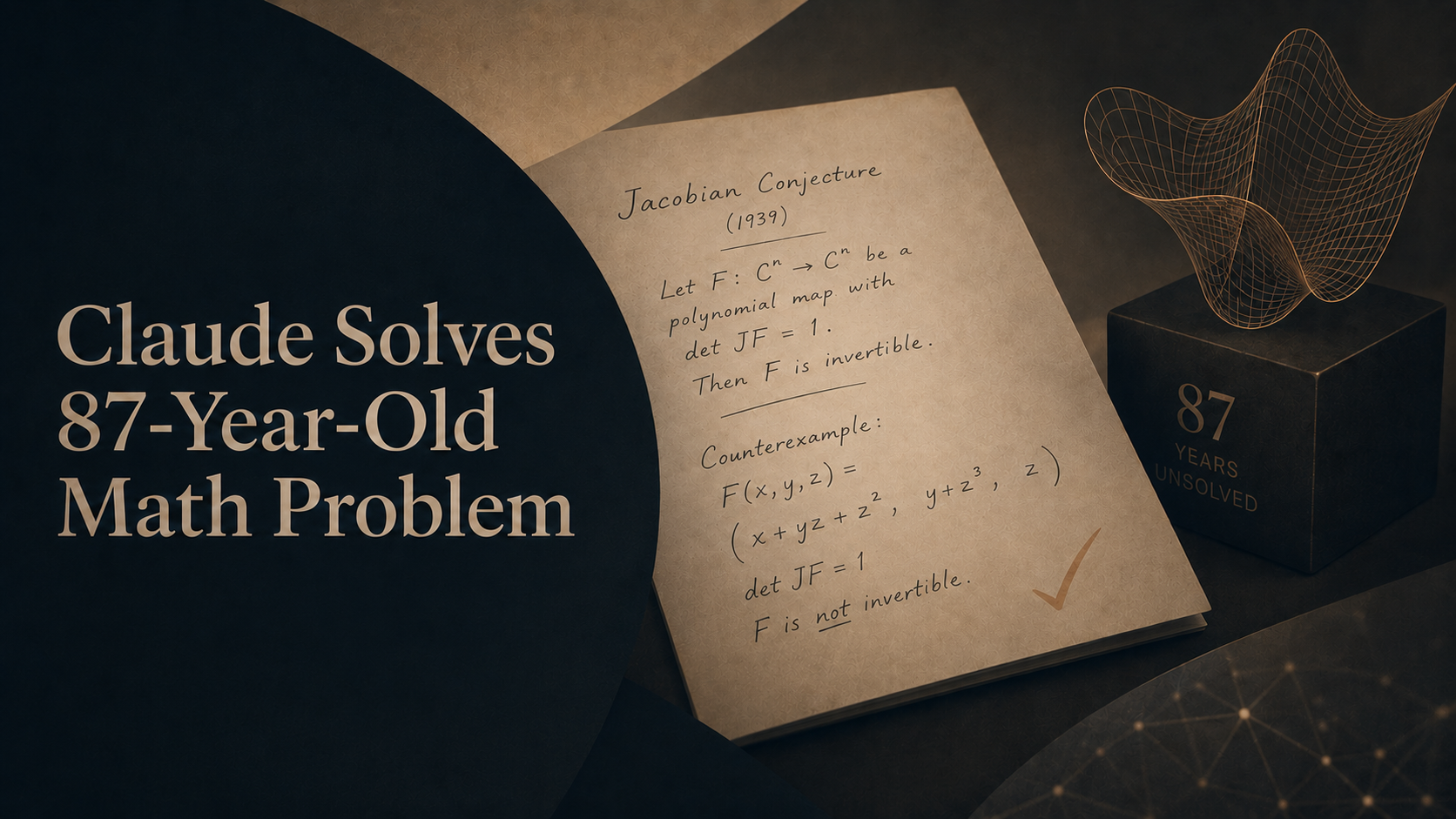
On July 20, a mathematician at Anthropic used the company's most advanced model, Claude Fable 5, to settle a famous math question that had stood open since 1939. The problem, known as the Jacobian conjecture, is one professional mathematicians had chipped away at for 87 years without an answer. Claude produced a short counterexample, essentially one specific case that proves the long-standing assumption wrong, and it did it in a few lines. Within hours, mathematicians around the world checked the work by hand and agreed it held up. The same week, a group led by a Nobel Prize winning physicist reported that Claude helped them solve a physics puzzle that had been open for years, with one saying it shifted his view of what these tools can do. The catch: the AI found the answer but could not explain why it works. It delivered the result the way a calculator does, without the human story of how it got there.
What it all means: For two years people argued about whether AI could do real, original work at the frontier of hard science or only remix what humans already knew. This week it did the former, in public, on a problem with an 87-year losing streak. What is left unsolved is understanding, because a correct answer that nobody can explain is powerful and unsettling at the same time.

+ Google Released Cheaper, Faster AI, And One Built To Hunt Security Holes

On July 21, Google released three new versions of its Gemini AI aimed at speed and cost rather than raw power. The main one, Gemini 3.6 Flash, does the same everyday work while using up to 17 percent fewer of the units companies pay for, which lowers the bill. A second is tuned for very high volume, and a third is a specialized model built to find, confirm, and patch security weaknesses in software. That security model will be available only to governments and trusted partners at first. Google still has not shipped its long-delayed flagship, Gemini 3.5 Pro, which has slipped several times over reliability problems. So the company led with cheaper and faster while the top-tier model stays in the shop.
What it all means: The race at the top of AI is now matched by a race to the bottom on price, and this is Google's move in it. Making the same work cost less is how these companies compete for the businesses that run them at scale. The security model is the one to watch, because the same tools that find holes to fix are the tools that find holes to exploit.

+ ChatGPT Can Now Read Your Health Records

On July 23, OpenAI relaunched a feature called Health in ChatGPT that connects the chatbot to your Apple Health data and, in the US, to medical records from supported hospital systems and services like One Medical. Once connected, ChatGPT can compare your lab results over time, summarize what changed since your last appointment, and spot patterns across your sleep, exercise, and daily activity. It is open to logged-in users 18 and older on both the free and paid plans. This is a relaunch with wider access than the first test version. The trade is straightforward: more useful health analysis in exchange for handing sensitive medical information to another company. Observers noted that Apple's own assistant can keep that data on your device, while sending it to ChatGPT means sharing it outward.
What it all means: AI is moving into the most personal records you have, and it is doing it as an opt-in convenience rather than a mandate. The analysis can genuinely help you walk into a doctor visit better informed. The cost is that your medical history becomes one more thing living on a company's servers, and that is a choice worth making on purpose.

More Stories

Anthropic Split Who Gets Its Top Model By Plan.

Starting July 20, Anthropic changed access to Fable 5, its most advanced model. Top-tier Max and premium team plans keep it included, while lower Pro and standard plans now pay per use through credits, cushioned by a one-time $100 credit. A promotion that had let all paying users tap Fable ended July 19.

An AI Startup Raised $1.5 Billion In One Round.

Fireworks AI, which helps companies turn general AI models into specialized versions trained on their own data, raised $1.5 billion this week, one of the largest rounds of the year. The money underscores where investors think the value sits: not the models themselves, but the work of fitting them to a specific business.

Magic Leap Cut About 200 Jobs And Changed What It Does.

The augmented-reality pioneer Magic Leap cut nearly 200 jobs on July 22 and pivoted to selling optical parts to other manufacturers instead of making its own headset. It is a reminder that not every company riding the computing wave survives it.

A Nonprofit Is Trying To Build A Free, Public AI For Everyone.

Current AI, a nonprofit backed by the French government, DeepMind, Salesforce, and major foundations, detailed a $400 million plan to build an open, free alternative to Big Tech's AI, modeled on the early open web. Its pitch: if AI is going to touch everyone's life, there should be a public option that no single company owns.

Why It Matters

This week the tools stopped talking about what AI might do and showed it. An AI settled a math problem 87 years of humans could not, and did it in a few lines. The rest of the week was about how that power reaches you: Google cutting the price of everyday AI so it spreads faster, and OpenAI pointing the technology straight at your medical records. The capability is proven. Where it lands, and what it costs to get it, is the story now.

For You

The AI in your pocket is getting cheaper and far more personal at the same time. Google's price cut eventually shows up as cheaper or free tools for you. OpenAI opened ChatGPT to your lab results and Apple Health, which can help you understand your own body and also moves your medical history onto a company's servers. And a nonprofit is betting $400 million that there should be a free, public version of all this that no single company owns. More power and more convenience, with more of your life running through a handful of companies, all at once.

For Your Work

The money is following results, not promises. A single AI startup raised $1.5 billion this week for the unglamorous job of fitting models to one company's data, which is exactly the work that pays off inside a real business. Google made its everyday model cheaper in the same week, which means the price your finance team wrote down for AI a few months ago is already too high. The advantage is shifting to the people who can take a capable, cheap model and make it do a specific job well.

One Thing To Try This Week

How to Use AI's Deep Thinking Mode for a Hard Problem

Last week we compared the same question across all three assistants to see where they agreed. This week we slow one of them down. Every big assistant now has a mode that makes it think longer before it answers, and it is the difference between a quick guess and worked-out reasoning. After an AI cracked an 87-year-old math problem this week, the lesson is simple: when the problem is hard, tell the tool to take its time.

Claude (via Cowork or claude.ai)

  1. Go to claude.ai and start a new chat. Click the model name next to the send button.
  2. Turn on the "Extended" thinking toggle, and raise the effort level if you see one. This tells Claude to reason through the problem before it replies.
  3. Ask your hard question. When it answers, click the "Thinking" section above the reply to see the steps it worked through, which helps you trust or challenge the result.

ChatGPT

  1. Go to chatgpt.com and start a new chat.
  2. Open the model picker in the message box and choose a Thinking option. On some plans you tap the + in the message box and select Thinking instead.
  3. Ask your question. It will take longer and may show a short note before it reasons. You can even add a clarification while it is still thinking.

Microsoft Copilot

  1. Go to copilot.microsoft.com or open the Microsoft 365 Copilot app and type your question.
  2. Before you send, choose the conversation mode under the box and select Think Deeper.
  3. Send it. Copilot takes extra time and shares its chain of thought as it works toward a more careful answer.
Bonus: Deep thinking modes are slower and, on some plans, have tighter usage limits. Save them for the questions that actually need the horsepower and use the normal mode for quick lookups.
Try This Prompt
Think step by step before you answer. Work through this problem carefully, show your reasoning, then give me your final answer and flag anywhere you had to make an assumption: [paste your hard question here]

Spread The Word

Love the Wyecliff Weekly? Refer a friend and earn rewards on our referral program.

See the referral tiers
Wyecliff Weekly

Never miss an edition.

Wyecliff Weekly lands every Friday at 6 AM Mountain. One short email with the moves that matter, a prompt to run on Monday, and one playbook from the field.

One email a week. No spam. Unsubscribe anytime.

Common Questions

When does Wyecliff Weekly arrive?
Every Friday morning at 6 AM Mountain. One email a week with the biggest AI stories, what they mean for your work, and one thing to try before Monday.
Is Wyecliff Weekly free?
Yes. Subscribe with your work email and read every edition at no cost. We write for operators who want plain takes, not a sales pitch.
What is inside each edition?
Top AI news with context, a short take on why it matters for your business, and one practical prompt or workflow you can run this week.
How do I unsubscribe?
Every email includes an unsubscribe link at the bottom. One click and you are off the list. No hoops.
/newsletter/wyecliff-weekly-edition-33