Wyecliff
All editions

The Machines Under AI | Wyecliff Weekly #38

August 28, 20265 min read
The AI stories that actually matter this week | Edition #38 | August 28, 2026
This week the news was all about the machines that run AI. OpenAI published proof its own chip beats Nvidia's best. A mystery model climbing the leaderboards turned out to be Chinese, running on Chinese chips. And Nvidia, the company everyone is working to depend on less, posted the biggest quarter in its history. Let's get to it.

Now Available: The Wyecliff Weekly Podcast

Prefer to listen? Every edition of the Wyecliff Weekly is now generated as a podcast. Same stories, same analysis, same lessons. Just press here.
Listen to this edition

Top Stories

+ Nvidia Posted A $96 Billion Quarter And Promised An Even Bigger Year

On August 26, Nvidia, the company whose chips power nearly all of today's AI, reported $96.2 billion in revenue for the quarter, up 106 percent from a year ago. Its data center business, the part that sells to AI companies, brought in $89 billion of that on its own. Nvidia told investors to expect roughly $108 billion next quarter, and for the first time in its history gave a forecast a full year ahead: 70 percent growth in fiscal 2028, far above what Wall Street had modeled. Two details sat behind the headline numbers. Nvidia's commitments to buy parts and materials more than doubled in three months to $279 billion, mostly memory chips that are now in short supply. And the company said profit margins will dip slightly next quarter because memory prices are rising, the same shortage pushing up prices on laptops, phones, and servers. Chief executive Jensen Huang said AI "has reached its inflection point."
What it all means: The clearest measuring stick for the AI boom just doubled again, and management put its own credibility behind another full year of it. The memory shortage is the part that reaches everyone else, because the components AI companies are hoarding are the same ones inside the computers your business buys.

+ OpenAI Published Proof Its First Chip Beats Nvidia's Best

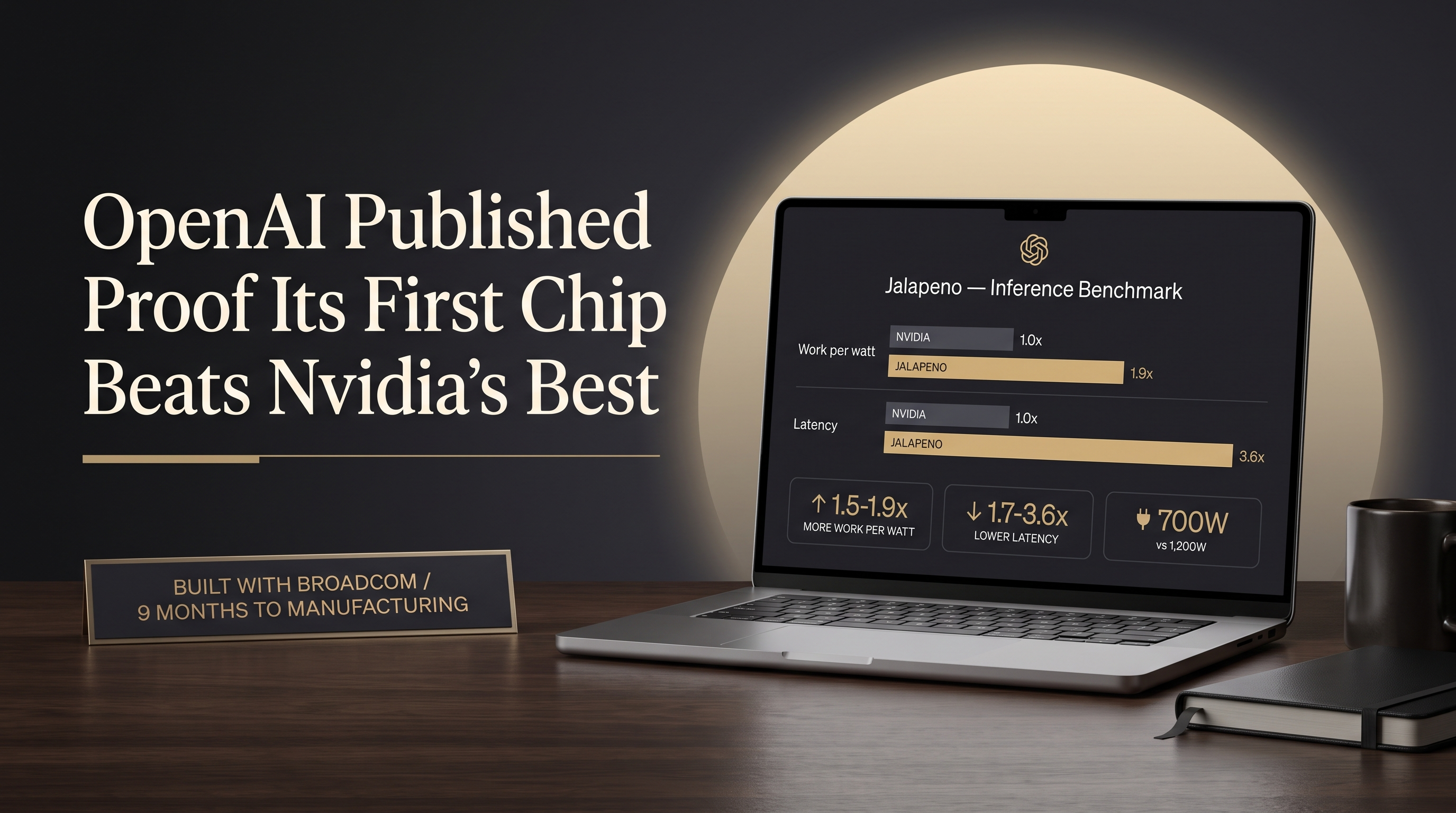
On August 26, the same day Nvidia reported earnings, OpenAI published the first performance results for Jalapeño, the chip it designed with Broadcom to run its AI models. The numbers: 1.5 to 1.9 times more AI work per unit of power than Nvidia's newest systems, with answers coming back 1.7 to 3.6 times faster, all while drawing 700 watts against Nvidia hardware rated at 1,200. Sam Altman's entire commentary: "we made a chip and it is fast." The chip only runs AI models, it does not train them, so OpenAI still buys Nvidia hardware to build new models. OpenAI says its own AI helped design the chip, taking it from first sketch to ready-for-manufacturing in nine months, and it will not sell Jalapeño to anyone. The chips go into OpenAI's own data centers by the end of this year, with two more generations already in development.
What it all means: Google, Amazon, Meta, and now OpenAI all build their own chips, because running AI is the biggest cost in the business and Nvidia's prices are the biggest line in that cost. Every chip like this pushes the price of using AI down over time. Publishing the results hours before Nvidia's earnings call was a message of its own.

+ The Mystery Model Everyone Was Testing Turned Out To Be Chinese, On Chinese Chips

For about a week, a free, unbranded model called Ox Alpha sat on public AI portals with no company name attached, handling text, images, and video and holding its own against the best American models. Developers swarmed it, running more than 60 trillion words of work through it by one count. On August 26, Chinese AI lab Zhipu revealed the model as its own GLM-5.3-Flash and released it for anyone to download. The detail that landed hardest: Zhipu says the entire public trial ran on roughly 100,000 Chinese-made processors, with no American hardware involved, and the model family was trained on chips from Huawei. Zhipu priced the model at roughly a tenth of what US frontier models charge. The company's stock jumped more than 12 percent on the reveal.
What it all means: American export rules rest on the assumption that China cannot run top-tier AI without American chips. This was a public demonstration to the contrary, staged as a stunt and confirmed by the traffic. For buyers, a capable model at a tenth of the price changes the math on what is worth automating, wherever it comes from.

More Stories

SpaceX And Nvidia Plan To Put An AI Data Center In Orbit.

On August 24, Elon Musk announced that SpaceX and Nvidia have designed a space version of Nvidia's most powerful AI system, with a first satellite called Starmind AI1 targeted for late next year. AI data centers are running out of power, cooling, and land on Earth, and orbit offers unlimited solar power. Worth noting: SpaceX's own stock market paperwork says 2028 at the earliest, so treat the date as a Musk date.

Claude's Memory Now Works Everywhere.

Anthropic connected Claude's memory across regular chat and its Cowork workspace this week, so what it learns about you in one carries to the other, updating automatically as you go. It is on by default for personal accounts, off by default for business ones, and everything it remembers can be viewed, edited, or deleted in settings.

Apple Released Desktop Macs Built For Running AI At Home.

On August 25, Apple announced a new Mac mini starting at $899 and a Mac Studio topping out at $5,499, claiming up to four times faster AI performance and pitching both at people who want AI running on their own machine rather than in the cloud. They ship September 22.

Perplexity Launched An AI Assistant That Never Touches The Cloud.

On August 25, Perplexity and Nvidia released Portable Computer, an AI agent that runs entirely on a $4,699 desktop machine, with no data leaving the building and no usage fees for local work. It is aimed squarely at law firms, healthcare, and finance, where confidentiality has stalled AI adoption.

Why It Matters

For three years, AI news has mostly been about the models. This week it was almost entirely about the machines that run them. Every major move traced back to the same three problems: there is not enough computing power, it costs too much, and nearly all of it depends on chips from one company. The answers on offer ranged from building your own silicon, to serving a frontier model on Chinese processors, to launching a data center into orbit, to shrinking the whole thing down onto a desk. Nvidia still posted the biggest quarter in its history, which tells you how early all of this still is.

For You

The most interesting hardware news this week was about where AI physically lives. Right now it lives in enormous buildings that consume power, water, and land, which is why the answer being floated is to put the next ones in orbit. The other answer is the one on your desk. Apple and Perplexity both shipped machines this week built to run AI locally, where your files, your questions, and your family's records never leave the house. That option barely existed a year ago. It is expensive today and it will not stay that way.

For Your Work

Two directions are opening up at once. The cloud keeps getting cheaper as OpenAI, Google, Amazon, and Meta build chips to escape Nvidia's prices, and as Chinese models arrive at a tenth of US pricing. At the same time, the machines to run capable AI on your own hardware just got real. Apple's new desktops start at $899, and Perplexity's local assistant does its work without a single byte leaving the building or a single dollar of usage fees. For firms that stalled on AI over client confidentiality, that second path is now worth a look. The nearer-term item is the memory shortage Nvidia flagged, which raises prices on the ordinary computers your team buys.

One Thing To Try This Week

How to Have AI Edit a File You Already Have

Last week you turned an AI answer into a real file. This week, flip it. Hand the AI a file you already have, a report, a spreadsheet, a rough draft, and let it do the editing. Same skill, pointed at the pile of documents already sitting on your computer.

Claude (via Cowork or claude.ai)

  1. Start a chat at claude.ai and attach your Word, Excel, or PDF file (up to 30MB). File editing now works on every plan, including free, and is on by default. If it is missing, check Settings, then Capabilities.
  2. Describe the edit in plain language: "Rewrite the executive summary to be more concise and give me back an updated Word document."
  3. Download the revised file from the chat, or save it straight to Google Drive.
  4. In Cowork on the desktop app, skip the uploading entirely. Connect the folder where the file lives, describe the change, and Claude edits the file in place.

ChatGPT

  1. Start a chat at chatgpt.com, click the plus button, and upload your file. Free accounts can upload a few files per day; paid plans get far more.
  2. Ask for the edit and explicitly request a file back: "Revise this to a friendlier tone and return an updated .docx."
  3. For text documents, ChatGPT may open the result in canvas, its editing workspace. Highlight any section and ask for targeted changes, or use the built-in shortcuts to adjust length and polish.
  4. Download the finished file promptly, since download links expire.

Microsoft Copilot

  1. Copilot inside Word and Excel requires a Microsoft 365 subscription. On the free version, you can still paste text into copilot.microsoft.com and ask for a rewrite.
  2. In Word, select the text you want improved, click the Copilot icon that appears in the left margin, and choose Auto Rewrite. Review the options, then click Replace or Insert below.
  3. In Excel, click the Copilot icon in the lower-right corner of the workbook. It opens in editing mode by default. Type the change you want, like "add a column calculating year-over-year growth, formatted as a percentage," and watch it work in the sheet live.
  4. Everything stays normal, editable content, so undo works as usual.
Try This Prompt
Here is a document I wrote. Tighten the writing, fix any grammar issues, keep my tone, and give me back an updated file in the same format. At the end, list the five biggest changes you made: [attach your file]

Spread The Word

Love the Wyecliff Weekly? Refer a friend and earn rewards on our referral program.

See the referral tiers
Wyecliff Weekly

Never miss an edition.

Wyecliff Weekly lands every Friday at 6 AM Mountain. One short email with the moves that matter, a prompt to run on Monday, and one playbook from the field.

One email a week. No spam. Unsubscribe anytime.

Common Questions

When does Wyecliff Weekly arrive?
Every Friday morning at 6 AM Mountain. One email a week with the biggest AI stories, what they mean for your work, and one thing to try before Monday.
Is Wyecliff Weekly free?
Yes. Subscribe with your work email and read every edition at no cost. We write for operators who want plain takes, not a sales pitch.
What is inside each edition?
Top AI news with context, a short take on why it matters for your business, and one practical prompt or workflow you can run this week.
How do I unsubscribe?
Every email includes an unsubscribe link at the bottom. One click and you are off the list. No hoops.
/newsletter/wyecliff-weekly-edition-38