Wyecliff
All editions

Edition #37: The Week AI Showed Its Work

August 21, 20265 min read
The AI stories that actually matter this week | Edition #37 | August 21, 2026
This was the week the AI industry showed its work. OpenAI's real finances became public for the first time on the road to a trillion dollar stock market debut. Elon Musk's Cursor launched a challenger to GitHub on the very day GitHub went down. And Anthropic sent Claude's science homework to a real laboratory, and the designs worked. Let's get to it.

Now Available: The Wyecliff Weekly Podcast

Prefer to listen? Every edition of the Wyecliff Weekly is now generated as a podcast. Same stories, same analysis, same lessons. Just press here.
Listen to this edition

Top Stories

+ OpenAI's Books Went Public, And The Numbers Are Wild In Both Directions

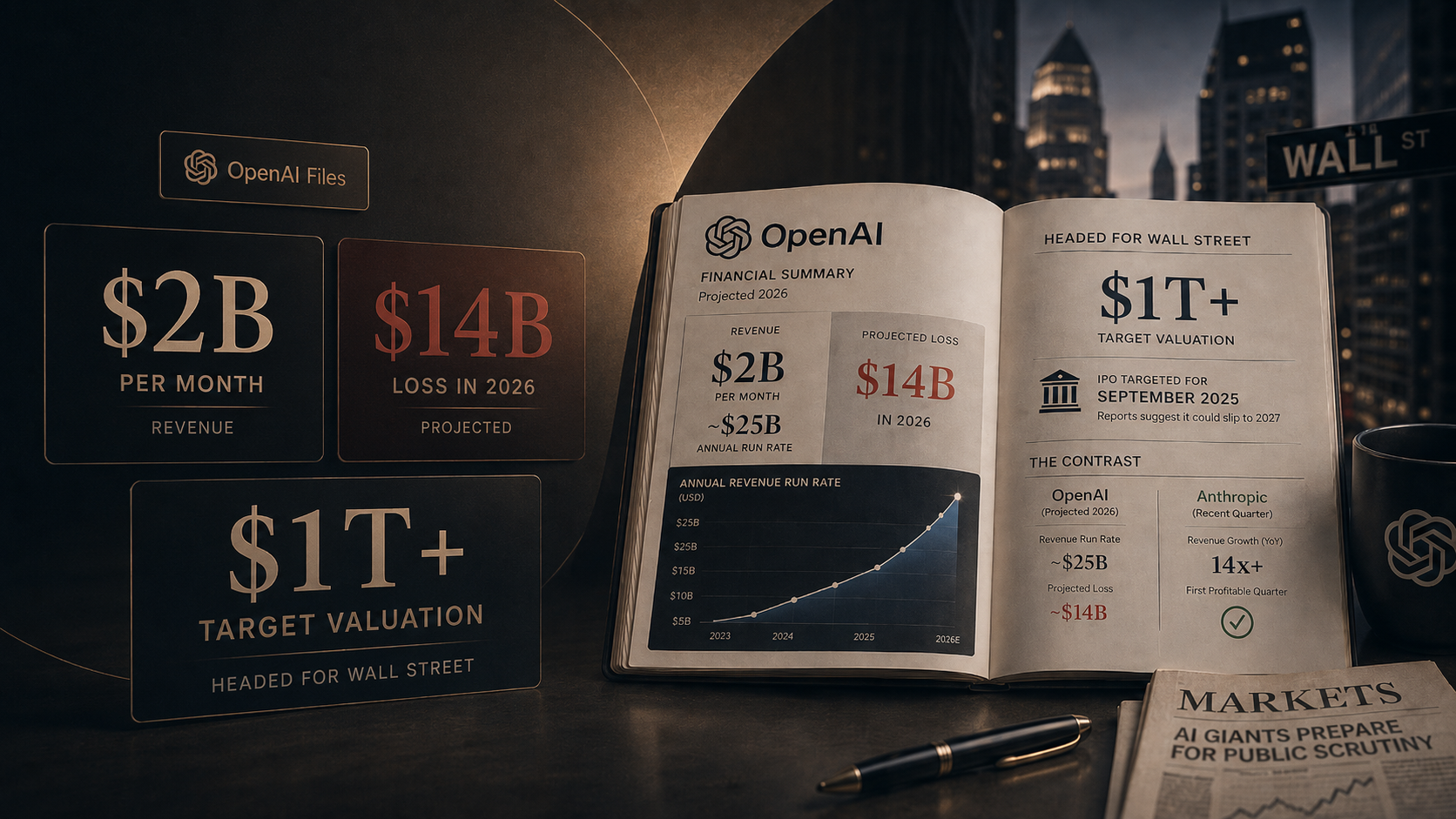
On August 17, reporting on OpenAI's stock market paperwork gave the public its first real look at the company's finances. The headline numbers: roughly $2 billion in revenue every month, about $25 billion a year at the current pace, against a projected loss of around $14 billion for 2026. OpenAI is targeting a stock market debut at a value above $1 trillion, with the biggest banks on Wall Street running the deal, though reports this week suggested the listing could slip from September into 2027. The contrast with its chief rival is hard to miss. Days earlier, Anthropic reported its first profitable quarter, with revenue that has grown more than 14 times in a year. Two companies selling similar products are now telling two very different financial stories, and both are about to let the public invest.
What it all means: Until now, judging these companies meant trusting their press releases. Stock market rules change that, because filings have to hold up under legal scrutiny. Anyone whose business runs on these tools can now see what the provider actually earns and loses, and one of the two biggest names in AI is losing $14 billion a year while asking to be valued above a trillion dollars.

+ Musk's Cursor Launched A GitHub Rival On The Day GitHub Crashed

On August 18, Cursor, the AI coding company SpaceX finished buying for $60 billion just three days earlier, launched Origin, a new home for storing and collaborating on software code. That puts it in direct competition with Microsoft-owned GitHub, the site where most of the world's software teams keep their work. The timing was brutal: the same day, GitHub suffered a worldwide outage that degraded the site for more than six hours, with nearly one in five requests failing. The outage was not a one-off. One analysis counts 257 GitHub outages over the past year, and GitHub's own technology chief admitted the platform "wasn't built for the scale it's now being asked to handle." Much of that new scale comes from AI coding agents hammering the site with automated work, which is exactly the traffic Origin says it was built for.
What it all means: We covered SpaceX's $60 billion offer for Cursor back in April, and this is what the money was for. Microsoft has owned the ground software gets built on for years, and a competitor with Musk's resources just moved in on the worst possible day for the incumbent. When a service everyone depends on stumbles this often, someone eventually builds the alternative.

+ Claude Designed New Drug-Style Molecules, And A Real Lab Proved They Work

Proteins are the tiny machines that do almost everything in your body, and most modern medicines work by grabbing onto one of them and changing what it does, the way a drug blocks a virus or shuts down a growth gone wrong. On August 19, Anthropic published results showing Claude invented new proteins from scratch, each one shaped to grab a specific disease-related target. Claude ran the project largely on its own for 48 hours. It planned the designs, operated specialist scientific software, judged its own results, and kept refining without a human steering. Then came the real test. A laboratory physically built 1,320 of Claude's designs and checked whether each one actually stuck to its target. 354 of them did, and Claude succeeded against 14 of the 15 targets it was given. That success rate, roughly 23 to 27 percent, is about double the 10 to 15 percent human-led teams typically manage. On one target, human teams in a recent open competition succeeded 3.7 percent of the time. Claude hit 40 percent, and its single best design beat the competition's winner.
What it all means: Finding a molecule that grabs the right target is the slow, expensive first step of nearly every new drug, and it normally takes months of trial and error. Claude did it in two days at double the usual success rate, with a physical lab confirming the results. Anthropic is keeping this ability restricted in its most powerful model while it builds safeguards, because a tool that can design helpful proteins could be pointed at harmful ones too.

More Stories

Stripe Bought An AI Startup For More Than $7 Billion.

Stripe, the payments company, finalized a deal to buy OpenRouter, a service that gives customers one doorway to more than 400 AI models and routes each task to the best one for the price. OpenRouter was valued at $1.3 billion in May, so the price marks a more than fivefold jump in three months.

Nvidia Put $105 Billion Behind OpenAI's Ohio Data Center.

A securities filing revealed Monday that Nvidia will backstop up to $105 billion in financing for a massive OpenAI data center campus in Pike County, Ohio, built and run by SoftBank's SB Energy under a 20-year lease. The first capacity comes online in 2028.

Apple Built A China-Only AI Model With Alibaba's Help.

Apple developed its own AI model specifically for China with support from Alibaba, making it the first foreign company cleared by Beijing to run its own AI model there. The model will power Apple Intelligence features on iPhones in mainland China through a coming software update.

Anthropic's CEO Said The AI Backlash Is "Fundamentally A Crisis Of Trust."

After a prominent investor argued that Dario Amodei's safety warnings helped turn public opinion against AI, Amodei pushed back in a rare series of posts, arguing people distrust institutions generally and that only visible wins will fix it. His line: "The thing that will work is actually curing cancer."

Why It Matters

For years the AI industry has run on claims: claims about capability, claims about safety, claims about the business underneath. This week, an unusual amount of it got checked. Stock market paperwork put OpenAI's real revenue and losses on the record. An independent laboratory physically tested Claude's protein designs and published the scores. And a six-hour GitHub outage tested how much of the world's software work leans on a single service, on the exact day an alternative appeared. The receipts, for once, arrived with the announcements.

For You

The protein result is the version of AI progress that actually reaches your family. The slow first step of drug discovery just got measurably faster, which over time means conditions without good treatments today get real candidates sooner. It is also the kind of visible, concrete win that Anthropic's own CEO says is the only thing that will rebuild public trust in this technology. Watch for more results that come with lab scores attached, because that is what separates progress from promises.

For Your Work

The financial picture behind your AI tools is finally becoming visible, and it is uneven. One major provider is profitable and growing, another is losing $14 billion a year, and both want your long-term commitment. That is worth weighing the same way you would weigh any vendor's stability. The GitHub episode carries the same lesson from a different angle: the day a critical service stumbled, a funded rival appeared, and every team that kept its work portable had options while everyone else waited out the outage. Portability and a second option are turning into the cheapest insurance in software.

One Thing To Try This Week

How to Turn an AI Answer Into a Real File You Can Open

Last week you pulled a table out of a photo or screenshot. This week, stop copying and pasting the results. All three assistants can now hand you an actual file, a real spreadsheet or document that opens in Excel or Word, formatted and ready to send.

Claude (via Cowork or claude.ai)

  1. On a paid plan at claude.ai, go to Settings, then Features, and turn on file creation if it is not already on. In Cowork it is built in, and Claude saves files straight to your folder.
  2. Give Claude the content, like last week's extracted table, and ask for the file: "Turn this into an Excel spreadsheet with a header row and a totals row."
  3. Download the finished file from the chat, or save it to Google Drive. Claude can create Excel, Word, PowerPoint, and PDF files.

ChatGPT

  1. Paste in your table or content and ask directly: "Create an Excel file from this and give me a download link."
  2. ChatGPT builds the file and posts a download link in the chat.
  3. Download it promptly, since links expire, and open it to check the numbers before you send it anywhere.

Microsoft Copilot

  1. Ask Copilot for your content as a table at copilot.microsoft.com or in the Copilot app.
  2. If you have Microsoft 365 Copilot through work, longer answers and tables show an export option that sends the result straight into Excel, Word, or PowerPoint. Click it and the file opens ready to edit.
  3. On the free version, copy the table and paste it into Excel, then ask Copilot in Excel to format it and add totals.
Try This Prompt
Turn this table into a spreadsheet file I can download. Add a header row, format any dollar amounts as currency, sort by the first column, and add a totals row at the bottom: [paste your table]

Spread The Word

Love the Wyecliff Weekly? Refer a friend and earn rewards on our referral program.

See the referral tiers
Wyecliff Weekly

Never miss an edition.

Wyecliff Weekly lands every Friday at 6 AM Mountain. One short email with the moves that matter, a prompt to run on Monday, and one playbook from the field.

One email a week. No spam. Unsubscribe anytime.

Common Questions

When does Wyecliff Weekly arrive?
Every Friday morning at 6 AM Mountain. One email a week with the biggest AI stories, what they mean for your work, and one thing to try before Monday.
Is Wyecliff Weekly free?
Yes. Subscribe with your work email and read every edition at no cost. We write for operators who want plain takes, not a sales pitch.
What is inside each edition?
Top AI news with context, a short take on why it matters for your business, and one practical prompt or workflow you can run this week.
How do I unsubscribe?
Every email includes an unsubscribe link at the bottom. One click and you are off the list. No hoops.
/newsletter/wyecliff-weekly-edition-37