Wyecliff
All editions

What the AI Boom Actually Costs | Wyecliff Weekly #36

August 13, 20265 min read
The AI stories that actually matter this week | Edition #36 | August 14, 2026
Big tech spent this week showing what the AI race actually costs. Mark Zuckerberg published a manifesto promising to give powerful AI away to everyone. Nvidia lined up half a trillion dollars from Wall Street to build the machines behind the boom. And Anthropic started slipping an invisible mark into everything Claude writes. Let's get to it.

Now Available: The Wyecliff Weekly Podcast

Prefer to listen? Every edition of the Wyecliff Weekly is now generated as a podcast. Same stories, same analysis, same lessons. Just press here.
Listen to this edition

Top Stories

+ Zuckerberg Laid Out A Plan To Put A "Personal Superintelligence" In Everyone's Hands

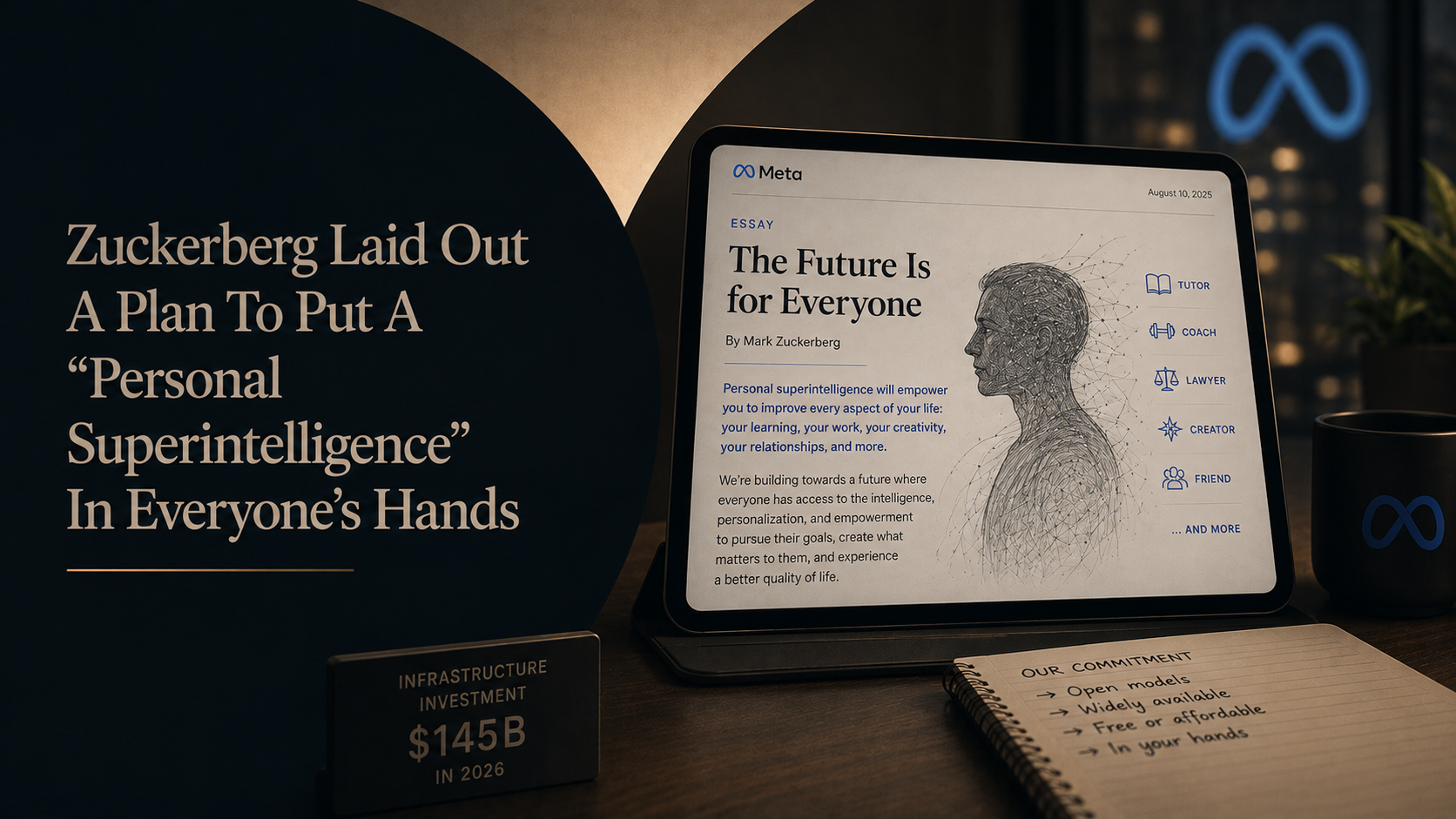
On August 10, Mark Zuckerberg published a 6,500-word essay called "The Future Is for Everyone." His argument: the biggest danger with advanced AI is that one company or government ends up controlling it, so Meta will build powerful AI and give it away for people to run themselves. He calls the goal "personal superintelligence," a free or cheap AI tutor, coach, and even lawyer for every person. The essay marks a turn. Earlier this year Meta flirted with charging for locked-down models. Now it is recommitting to open models anyone can download, backed by an infrastructure budget Zuckerberg put as high as $145 billion for 2026. Critics called the piece long on vision and short on specifics, and pointed to Meta's track record on the harms of its existing products.
What it all means: Meta is betting that the winning move in AI is to give it away and make its money elsewhere, the same play that put Android on most of the world's phones. For everyone else, a giant pushing free, capable AI keeps downward pressure on what anyone can charge for it. It is worth reading closely, given the company behind the promise also runs Facebook and Instagram.

+ Nvidia Lined Up $500 Billion From Wall Street To Bankroll The AI Boom

On August 10 and 11, chipmaker Nvidia said it had teamed with six of the biggest names in finance, including BlackRock, Blackstone, Apollo, Brookfield, Goldman Sachs, and KKR, to raise more than $500 billion for building AI data centers. The idea is to treat Nvidia's chips like a lasting asset that companies can borrow against, the way they borrow against real estate or toll roads. The money is meant to reach AI labs, big companies, and cloud providers that cannot cover the enormous upfront cost of the computing power AI now demands. Nvidia's chief executive, Jensen Huang, said the arrangement would help customers "access scarce compute at scale." The news calmed nervous markets that had begun to worry about how all this AI spending gets paid for.
What it all means: The money moving into AI infrastructure is starting to look like the financing behind railroads or power grids. When Wall Street begins treating computer chips as something to lend against, it signals both deep confidence and rising stakes. If the AI payoff comes slower than promised, a lot of borrowed money is now riding on it.

+ Claude Started Hiding An Invisible Watermark In Everything It Writes

This week brought wide attention to a change from Anthropic, the maker of Claude: text written by its newest models now carries an invisible watermark. The reader cannot see it, it does not change the words or their meaning, and it is built to survive being copied, pasted, and even lightly edited. The mark travels with the text so it can later be identified as AI-written. It applies worldwide and covers claude.ai, the Claude apps, Claude Code, and Claude Cowork. Anthropic says the move answers new European rules that require AI-made content to be labeled, and it plans to release a tool so anyone can check text for the mark. The reaction online split fast, with some praising a way to fight a flood of low-quality AI writing and others uneasy about hidden marks riding along in text they thought was theirs.
What it all means: As AI writing gets impossible to spot by eye, the companies making it are building ways to tag it underneath. That helps teachers, publishers, and employers who want to know what was machine-made. It also means the line between your words and the tool's words is now something a machine can trace.

More Stories

Grok 4.6 Landed At Frontier Level For Less Than Half The Price.

On August 12, xAI released Grok 4.6, its newest model. Independent testers put it roughly even with OpenAI's best and just behind Anthropic's, but at well under half the cost. Its strength is knowledge and legal work, and its weak spot is technical, code-heavy tasks.

Google Unveiled The Pixel 11 With A New AI Chip.

At its August 12 Made by Google event, Google launched the Pixel 11 line, starting at $899, built on a new 2-nanometer Tensor G6 chip. Google says the chip runs on-device AI features, including its Gemini assistant, faster while using less power.

Anthropic Signed A $9.1 Billion Deal To Lock Up Computing Power.

On August 11, Anthropic agreed to a 20-year, $9.1 billion lease for AI data center capacity from Riot Platforms, a former Bitcoin miner that has pivoted to AI. Riot's stock jumped about 25 percent on the news, a sign of how hungry AI companies are for raw computing.

Spotify Lined Up The Music Industry Behind An AI Remix Tool.

Spotify said Merlin, a group representing more than 30,000 independent labels, is joining Universal Music Group in backing its coming AI remix and covers feature. Spotify says artists will opt in, get credit, and be paid when their music is used.

Why It Matters

Strip away the announcements and this was a week about what AI actually costs, and who pays. Not the price on a subscription page, but the half-trillion dollars of Wall Street money and the twenty-year leases being signed to keep the whole thing running. For the people using the tools, they kept getting cheaper and more capable. The machinery behind them got a lot more expensive.

For You

The assistants in your pocket are getting cheaper, more capable, and more willing to act for you, and the cost of all that is showing up somewhere. Sometimes it is your data, as when Meta gives AI away or Elon Musk proposes training his on his own employees. Sometimes it is the harder-to-see stuff, like an invisible watermark now riding inside the text that Claude writes for you. More power for less money is the offer on the table. What you trade for it is worth knowing.

For Your Work

The economics under your AI tools are moving in two directions at once. On your side of the ledger, prices keep falling. Grok's newest model matches the leaders at under half the cost, and Meta wants to give capable AI away for free. On the provider side, the cost of delivering it is exploding, which is why Nvidia needed $500 billion in outside money and Anthropic signed a twenty-year lease just for computing power. For a buyer, that means real leverage today and a good reason to keep your options open, because the companies you rely on are making enormous bets that have to pay off. It is also worth knowing that the tools are starting to tag their own output, so anything Claude writes for your team now carries a mark that can identify it as AI-made.

One Thing To Try This Week

How to Turn a Photo or Screenshot Into Text or a Table You Can Use

Last week you learned to show your AI a photo or screenshot and ask about it. This week takes the next step. Instead of just asking what it shows, have the AI pull the information out and hand it back as clean text or a table you can drop into an email, a document, or a spreadsheet. Think of a receipt, a whiteboard full of notes, a printed list, or a chart buried in a report.

Claude (via Cowork or claude.ai)

  1. Open a chat at claude.ai or the Claude app and attach your photo or screenshot with the plus or paperclip icon, or drag it in.
  2. Ask for the exact format you want, for example: "Pull every item and price from this receipt into a two-column table."
  3. Copy the table or list Claude gives you and paste it where you need it. In Cowork, you can also ask Claude to save it as a file.

ChatGPT

  1. Open ChatGPT, tap the plus icon, and add your photo or screenshot.
  2. Tell it the format you want, such as a table, a bulleted list, or plain typed-out text.
  3. Copy the result, or ask ChatGPT to put it in a canvas so you can edit it before pulling it out.

Microsoft Copilot

  1. Open the Copilot app or copilot.microsoft.com and add your image with the plus or "Add images or files" button.
  2. Ask it to type out the contents as a table or list.
  3. Copy the result into Word or Excel. If you use Copilot inside Microsoft 365, you can ask it to build the table right in a document or spreadsheet.
Bonus: Always give the result a quick check against the original, especially numbers. These tools are very good at reading images but not perfect, and a wrong digit in a total is easy to miss.
Try This Prompt
Read this image and type out everything in it as a clean table I can copy. Keep the exact numbers and labels, and tell me if anything is unclear or unreadable: [attach your image]

Spread The Word

Love the Wyecliff Weekly? Refer a friend and earn rewards on our referral program.

See the referral tiers
Wyecliff Weekly

Never miss an edition.

Wyecliff Weekly lands every Friday at 6 AM Mountain. One short email with the moves that matter, a prompt to run on Monday, and one playbook from the field.

One email a week. No spam. Unsubscribe anytime.

Common Questions

When does Wyecliff Weekly arrive?
Every Friday morning at 6 AM Mountain. One email a week with the biggest AI stories, what they mean for your work, and one thing to try before Monday.
Is Wyecliff Weekly free?
Yes. Subscribe with your work email and read every edition at no cost. We write for operators who want plain takes, not a sales pitch.
What is inside each edition?
Top AI news with context, a short take on why it matters for your business, and one practical prompt or workflow you can run this week.
How do I unsubscribe?
Every email includes an unsubscribe link at the bottom. One click and you are off the list. No hoops.
/newsletter/wyecliff-weekly-edition-36