Wyecliff
All editions

Half The Price, Same Power | Wyecliff Weekly #31

July 10, 20265 min read
The AI stories that actually matter this week | Edition #31 | July 10, 2026
This week the AI world stopped sharing and started building walls. Meta built its own image maker instead of renting one. Microsoft cut 4,800 jobs and spent 2.5 billion dollars to send its engineers inside other companies. And SpaceX's AI group launched a model that undercuts the leaders on price. Let's get to it.

Now Available: The Wyecliff Weekly Podcast

Prefer to listen? Every edition of the Wyecliff Weekly is now generated as a podcast. Same stories, same analysis, same lessons. Just press here.
Listen to this edition

Top Stories

+ SpaceX's AI Group Released A Model That Undercuts The Leaders On Price

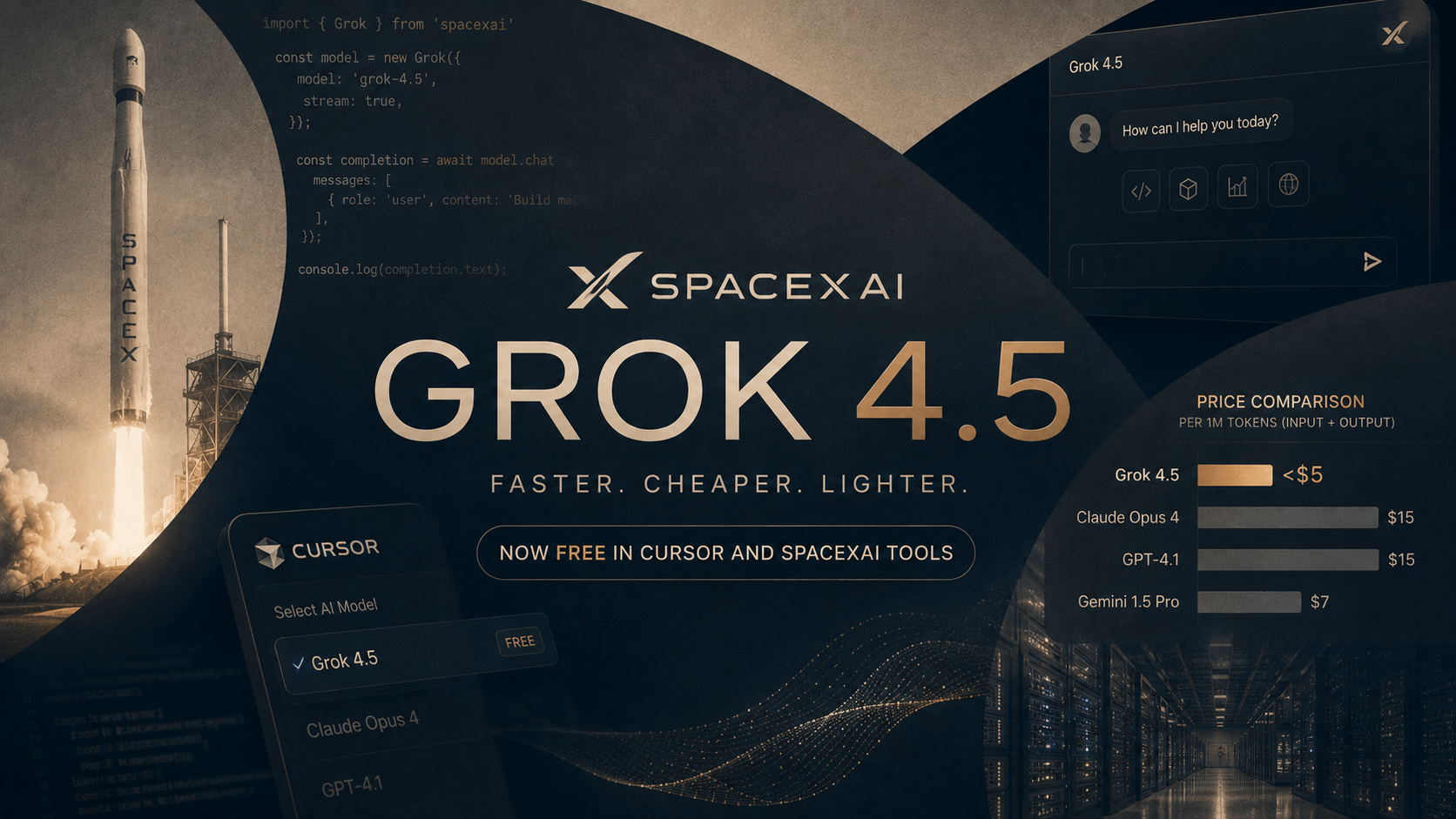
On July 8, SpaceXAI launched Grok 4.5, the first model it built together with Cursor since buying the coding company for 60 billion dollars. On the standard industry tests, it performs in the same range as the top models from Anthropic and OpenAI, while running faster and using far less computing to do the same work. SpaceXAI says it is roughly four times more efficient than Anthropic's flagship. The number that matters is the price. Grok 4.5 costs less than half of what Anthropic charges for its top model, and it is free for now inside Cursor and SpaceXAI's own tools. Elon Musk called it an Opus class model that is faster, cheaper, and lighter to run, and said a bigger one is coming next month. It is not yet available in Europe, which is expected in mid July.
What it all means: A year ago Grok was treated as an also-ran. It just matched the best models in the world at a fraction of the price, and it did it on efficiency rather than raw power. The frontier is getting crowded at the top and cheap at the same time, and any AI budget set this spring is already too high.

+ Microsoft Cut 4,800 Jobs And Spent 2.5 Billion Dollars To Help Companies Use AI

On July 6, Microsoft laid off about 4,800 people, roughly 2 percent of its staff, with its Xbox and sales teams hit hardest. Around 1,600 of the cuts were in Xbox, with more expected later this year. Microsoft's own people chief said the eliminated roles are not being replaced by AI, while acknowledging that AI is changing how the work gets done. It was part of a wider stretch that has seen about 154,000 tech jobs cut in the first half of 2026. Days earlier, Microsoft launched Microsoft Frontier Co., a 2.5 billion dollar business of about 6,000 people whose job is to sit inside customer companies and build AI tools for them on-site. Amazon announced a one billion dollar version of the same idea two days before that. Both companies are betting on the same problem: plenty of firms now have AI and cannot figure out how to use it, and closing that gap is worth billions.
What it all means: The money is moving from building models to putting them to work. Microsoft and Amazon spent the week betting that the bottleneck is adoption, and the layoffs are the other half of that bet. Routine roles are shrinking while the work of installing AI inside a real business is where the budgets now go.

+ Meta Built Its Own AI Image Maker Instead Of Renting One

On July 7, Meta released Muse Image, the first picture-making model from the new Superintelligence Labs group led by Alexandr Wang. It opened at number two on the public leaderboards for creating and editing images, behind only OpenAI. Unlike older tools that turn a prompt straight into a picture, Muse Image plans the layout first, can blend several photos, pulls in live information from the web, and edits its own results to improve them. It is free inside the Meta AI app and is rolling out across Instagram and WhatsApp, with Facebook and Messenger to follow. Meta also teased a video version coming soon. The bigger shift is behind the scenes: Meta used to pay outside companies to power its creative tools, and it just replaced them with something it owns.
What it all means: For a company whose products run on photos and video, owning the image engine outright matters as much as any feature it ships. Meta just cut out the outside suppliers it depended on and put a free, capable image maker in front of the billions of people already inside its apps. Everyone who paints, designs, or sells with images now has one more strong free option, built by the company that owns their feed.

More Stories

OpenAI Gave ChatGPT's Voice A Major Upgrade.

On July 8, OpenAI launched GPT-Live, a new voice version of ChatGPT that can listen and talk at the same time, cutting the awkward pauses of the old version and adding real-time translation. In OpenAI's own testing, users preferred it over the previous voice mode in about three of every four conversations.

Alibaba Banned Anthropic's AI Across The Company.

Reported the week of July 6, Alibaba ordered its employees to stop using Anthropic's Claude tools and uninstall them by July 10, citing security concerns, and pointed staff to its own in-house tool instead. It follows Anthropic's June accusation that Alibaba ran the largest known attempt to copy its AI. The two biggest AI economies are pulling apart in real time.

Rhode Island Passed New AI Laws.

This week Rhode Island's governor signed measures that ban anyone but a licensed professional from offering AI therapy, require chatbots to have safeguards for users talking about self-harm, and require doctors using AI to take visit notes to tell patients and check the notes for accuracy. The rules are in effect now.

Why It Matters

The open, borderless AI of the past two years spent this week hardening into something with owners and edges. Meta stopped renting its image tools and built its own. Microsoft built its own force of engineers to embed inside customers. And Alibaba threw out an American AI supplier and reached for a tool it made itself, with a ban that takes effect the same day this goes out. The pieces companies used to share and buy from each other are being pulled in-house and walled off by country.

For You

A free, capable image maker now lives inside Instagram and WhatsApp for billions of people, and ChatGPT's voice finally sounds like a real conversation. At the same time, the tools you use are being built and owned by a shrinking set of giants who are starting to draw national borders around them, so the model behind your favorite app could be swapped or blocked for reasons you never see. Rhode Island's new rules, banning AI therapy and forcing your doctor to tell you when AI is taking the notes, are the first sign of guardrails arriving in the parts of life where the stakes are personal.

For Your Work

The clearest bet of the week came from Microsoft and Amazon, which together put billions into sending their own people inside other companies to make AI actually work. That is where the spending is going, and it is the same reason Microsoft's routine roles are shrinking in the same breath. The skill being rewarded is the one that puts these tools to work inside a real business. And with Grok now matching the best models at less than half the price, the number your finance team wrote down for AI a few months ago is already stale.

One Thing To Try This Week

How to Get AI to Show Its Sources and Check Its Facts

Last week we turned a plain description into a finished visual. This week we make sure you can trust what comes back. After Anthropic showed that even its own engineers are still learning how their model thinks, the habit that protects you is simple: make the AI show its work and point you to where it got the answer.

Claude (via Cowork or claude.ai)

  1. Go to claude.ai. If web search is not already on, open Settings and turn it on, then start a new chat.
  2. Ask your question and add: "Search the web and give me your sources as links." Claude answers and shows the sources it used, which you can click to check.
  3. Follow up with "What in this answer should I double-check myself?" to get it to flag its own weak spots.

ChatGPT

  1. Go to chatgpt.com and start a new chat. Turn on the Search option so ChatGPT looks things up live rather than answering from memory.
  2. Ask your question and add: "Use the web and cite your sources with links." ChatGPT lists the pages it drew from.
  3. Open one or two of those links yourself. If a claim has no source, treat it as unconfirmed.

Microsoft Copilot

  1. Go to copilot.microsoft.com or open the Microsoft 365 Copilot app. Make sure web answers are turned on.
  2. Ask your question. Copilot grounds its answer in the web and shows numbered citations automatically, with links you can open.
  3. For anything important, click the Researcher option if you have it at work, which does deeper, fully cited work you can review.
Bonus: A note on judgment: a source link is not the same as a good source. Glance at who published it before you trust the claim. The point is to move from taking the AI's word for it to checking it in ten seconds.
Try This Prompt
Answer my question, then give me the three sources you relied on as links, and tell me one thing in your answer I should verify for myself before I use it: [paste your question here]

Spread The Word

Love the Wyecliff Weekly? Refer a friend and earn rewards on our referral program.

See the referral tiers
Wyecliff Weekly

Never miss an edition.

Wyecliff Weekly lands every Friday at 6 AM Mountain. One short email with the moves that matter, a prompt to run on Monday, and one playbook from the field.

One email a week. No spam. Unsubscribe anytime.

Common Questions

When does Wyecliff Weekly arrive?
Every Friday morning at 6 AM Mountain. One email a week with the biggest AI stories, what they mean for your work, and one thing to try before Monday.
Is Wyecliff Weekly free?
Yes. Subscribe with your work email and read every edition at no cost. We write for operators who want plain takes, not a sales pitch.
What is inside each edition?
Top AI news with context, a short take on why it matters for your business, and one practical prompt or workflow you can run this week.
How do I unsubscribe?
Every email includes an unsubscribe link at the bottom. One click and you are off the list. No hoops.
/newsletter/wyecliff-weekly-edition-31